
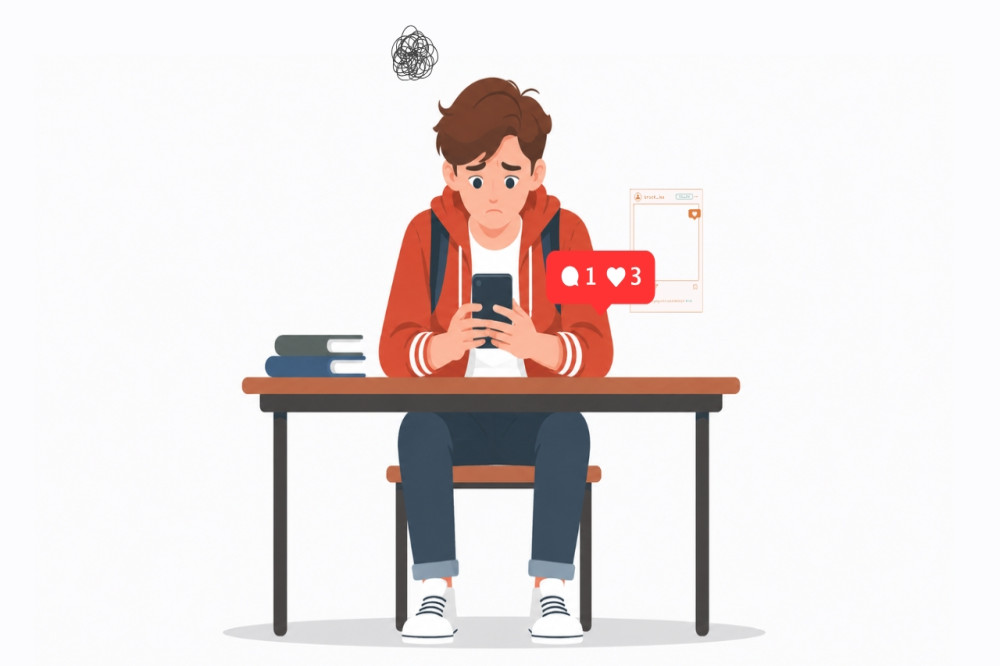
Scroll through any social media platform today, and you’ll notice something interesting.
Many students appear extremely confident online:
Well-edited photos
Smart captions
Funny reels
Strong opinions in posts
Perfectly curated profiles
But in real life, the same students may struggle with:
Speaking confidently in front of others
Expressing opinions in classrooms
Handling interviews
Starting conversations
Dealing with social anxiety
This gap between online personality and real-world confidence is becoming more common—and more concerning.
The question is not whether social media is good or bad.
The real question is: Why is confidence becoming easier to show online but harder to express in real life?
Social media allows students to carefully design how they want to be seen.
Unlike real life, online identity is:
Edited
Filtered
Rewritten
Reposted until perfect
Students can:
Delete mistakes
Re-record videos
Choose the best version of themselves
Over time, this creates a “curated self”—a version that feels controlled, polished, and safe.
But real-life interactions don’t offer that control.
And that’s where the gap begins.
One of the strongest drivers of social media usage is validation.
Likes, comments, shares, and views create:
Instant feedback
Quick emotional rewards
A sense of approval
For many students, this becomes easier than:
Face-to-face conversations
Classroom participation
Public speaking
Real-time social interaction
Because online validation feels:
Faster
Safer
Less judgmental (on the surface)
But over time, this can shift confidence away from real interactions and toward digital approval.
Many students today are not weak in knowledge—they are hesitant in expression.
They may:
Know answers but not speak up
Have opinions but avoid sharing them
Understand concepts but struggle to explain them
This happens because real-world communication requires:
Instant thinking
Emotional presence
Fear management
Social awareness
And when students spend more time communicating through screens, real-time communication starts feeling uncomfortable.
Even simple interactions can feel:
Overwhelming
Stressful
Judgment-heavy
Social media encourages students to present their best version at all times.
This leads to:
Fear of posting imperfect content
Overthinking captions
Avoiding vulnerability
Comparing themselves constantly
Gradually, students start believing:
“If I don’t look confident online, I am not confident.”
But confidence is not visual.
It is behavioral.
Real confidence is shown in:
Speaking clearly in person
Handling uncertainty
Expressing disagreement respectfully
Making decisions without fear
Online presence does not always reflect real personality strength.
When self-worth becomes linked to online response:
Fewer likes feel like rejection
More likes feel like approval
Comparison becomes constant
This creates a subtle emotional dependency on external validation.
Instead of asking:
“Do I like what I created?”
students start asking:
“Will others like it?”
Over time, this weakens internal confidence and increases dependence on external feedback.
Real-life interactions cannot be edited.
They involve:
Spontaneous responses
Awkward moments
Mistakes
Silence
Judgment
And because students are not used to imperfect communication environments, they may feel less prepared in:
Interviews
Group discussions
Presentations
Public speaking
It is not lack of intelligence. It is lack of exposure to unfiltered communication.
Social media itself is not harmful.
In fact, it helps students:
Express creativity
Learn new skills
Build personal brands
Connect with opportunities
The issue arises when:
Online identity becomes more important than real identity
Digital approval replaces real confidence building
Screen communication replaces human communication
Balance is what matters.
This gap does not suddenly appear in college or jobs.
It starts gradually when students:
Spend more time observing than interacting
Prefer texting over speaking
Avoid uncomfortable conversations
Seek validation before expression
By the time real-world communication becomes necessary, confidence feels underdeveloped.
Real confidence does not come from perfect profiles.
It comes from:
Repeated conversations
Real experiences
Small social risks
Making mistakes and learning
Speaking without overthinking
Confidence grows when students practice:
Expressing thoughts openly
Participating in discussions
Speaking in groups
Accepting imperfection
It is built in real environments—not curated ones.
Instead of focusing only on academic performance or screen time, guidance should also include:
Encouraging face-to-face conversations
Reducing fear of mistakes
Appreciating effort in communication
Allowing children to express opinions freely
Encouraging participation in real-world activities
Most importantly, children should feel safe expressing themselves without judgment.
Students do not need to abandon social media.
They need to:
Understand its limitations
Separate online identity from self-worth
Build real-world communication habits
Practice offline confidence regularly
A healthy balance ensures that:
Online presence supports growth
Real-life confidence remains strong
Many students today are not lacking intelligence or talent.
They are simply growing up in an environment where:
Online expression is easier than real expression
Digital validation is more frequent than real feedback
Curated identity is more visible than authentic confidence
At Career Map, we believe true confidence is not built through likes or followers, but through real-world communication, self-awareness, and consistent personal growth.
Because a strong online personality is valuable—but real confidence is what truly shapes a student’s future.
BIBILOGRAPHY
https://share.google/Rh18XYcao1NvtfZXC
https://share.google/b6DRI9xK1tYcXfy7q
https://share.google/X1O2NcH7TDObettN1
https://share.google/2ivz7Q1WUknPiuxNG
https://share.google/mwvnxDZBH4BXVkSlt




Hello !!
I'm a Career Bee