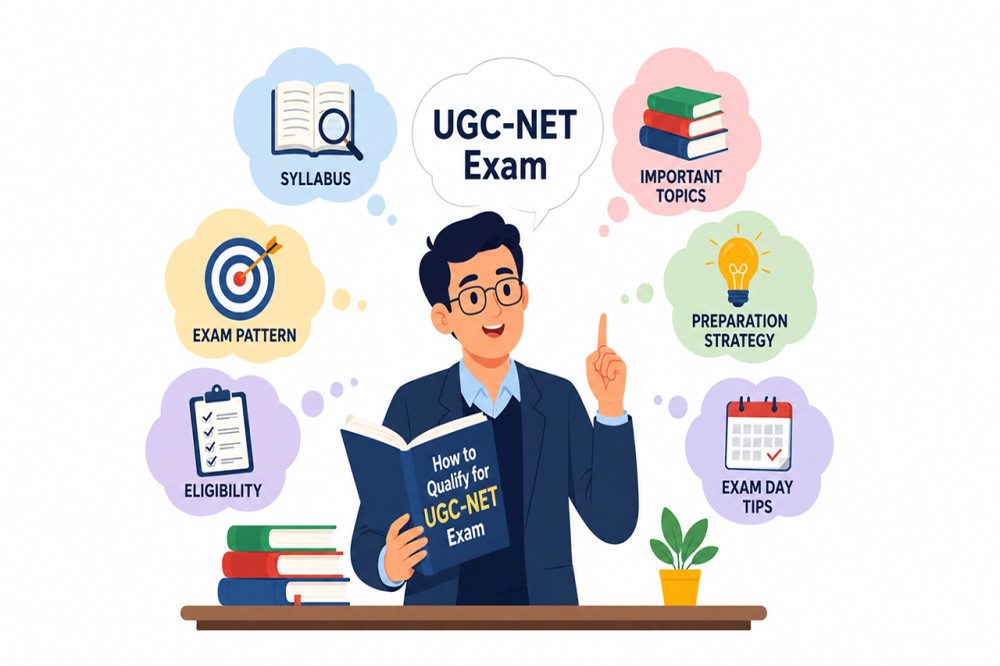
Teaching at the university level in India isn't a career you simply apply for after a postgraduate degree — it's a regulated, exam-gated profession. The single gateway that decides whether a postgraduate can become an Assistant Professor in most Indian universities and colleges is the UGC-NET exam. For students who enjoy their subject deeply enough to want to teach and research it for a living, understanding this exam early can save years of confusion later.
What Is UGC-NET?
UGC-NET (National Eligibility Test) is a national-level exam conducted by the National Testing Agency (NTA) on behalf of the University Grants Commission (UGC). It determines eligibility for two distinct academic paths:
- Assistant Professor — eligibility to teach at universities and colleges across India.
- Junior Research Fellowship (JRF) — a funded research fellowship for candidates pursuing a Ph.D., which comes with a monthly stipend.
Both outcomes are decided through the same exam, so candidates don't need to choose between them in advance — a single NET qualification can open either path, depending on the candidate's score and preference.
UGC-NET Eligibility Criteria
- Educational qualification: A Master's degree or equivalent from a UGC-recognised university, in a subject covered under NET's list of over 80 subjects (final-year postgraduate students can also apply).
- Minimum marks: 55% for General category, 50% for SC/ST/OBC-NCL/PwD/Third Gender candidates.
- Age limit for JRF: Generally up to 30 years, with standard government relaxations for reserved categories.
- Age limit for Assistant Professor eligibility: No upper age limit — this route remains open regardless of age.
- Nationality: Must be an Indian citizen.
UGC-NET Exam Pattern
The exam is conducted in a single session, Computer-Based Test (CBT) mode, with two papers, no negative marking:
- Paper I: Common for all candidates — tests teaching aptitude, research aptitude, reasoning ability, reading comprehension, communication, and general awareness about higher education systems.
- Paper II: Subject-specific — based entirely on the candidate's chosen postgraduate subject, from a list of over 80 subjects ranging from Commerce and History to Computer Science and Environmental Science.
The exam is held twice a year, typically in June and December sessions, giving candidates multiple attempts within a year to qualify.
How to Become a Professor: The Full Career Path
- Complete a Bachelor's degree, followed by a Master's degree with the required minimum percentage, in the subject you want to teach.
- Qualify UGC-NET (or state-level SET/SLET, which is valid for teaching within that specific state).
- Apply for Assistant Professor positions in universities and colleges once NET-qualified — many candidates also pursue a Ph.D. alongside or after this, since it significantly strengthens both eligibility and pay.
- Progress through the Career Advancement Scheme (CAS): Assistant Professors move up to Associate Professor and eventually Professor ranks over the years, based on experience, research publications, and institutional norms — this is a structured, multi-decade academic career ladder, not a single fixed designation.
- Candidates with a Ph.D. already completed before joining are eligible for three advance increments, effectively starting their career at a higher basic pay than those without one.
What This Pays: Assistant Professor Salary in India (2026)
- Entry-level basic pay (UGC 7th Pay Commission, Academic Level 10): ₹57,700 per month, within a pay band extending up to ₹1,82,400.
- In-hand monthly salary at central universities (including DA, HRA, and other allowances): typically ₹85,000–₹1.1 lakh per month in metro postings.
- State universities and government colleges: in-hand salary generally in the ₹55,000–₹75,000 per month range at entry level, varying by state and city category.
- Private colleges: often lower, typically ₹40,000–₹60,000 per month, though this varies significantly by institution reputation and funding.
- JRF stipend for NET-JRF qualifiers pursuing a Ph.D.: around ₹37,000/month for the first two years, rising to approximately ₹42,000/month as a Senior Research Fellow (SRF) in the third year.
- Pay increases substantially with promotions to Associate Professor (Level 11–12) and Professor (Level 13A–14) over the course of an academic career, alongside research grants, sabbaticals, and other academic benefits that aren't available in most private-sector jobs.
UGC-NET Preparation Strategy
- Understand the syllabus thoroughly first — both Paper I's general teaching/research aptitude and Paper II's subject-specific depth need separate preparation tracks.
- Build a structured study plan covering all units systematically, rather than jumping between topics — NET rewards conceptual clarity over last-minute cramming, since there's no negative marking but questions are designed to test genuine understanding.
- Use NTA-recommended books and previous years' question papers to understand question patterns and frequently tested areas.
- Take regular mock tests to build speed, accuracy, and exam-day confidence — this matters especially for Paper I, which many subject-experts underestimate.
- Coaching is optional, not mandatory — many candidates clear UGC-NET through self-study with the right materials and consistency, though structured coaching can help candidates who want external accountability or additional practice material.
- There's no limit on attempts for Assistant Professor eligibility, which means candidates shouldn't feel pressured by a single attempt — though JRF attempts are subject to the age limit, so serious research aspirants should plan attempts earlier.
Is This Career Right for You?
This path tends to suit students who:
- Genuinely enjoy their subject deeply enough to want to teach and research it long-term, not just clear an exam.
- Value job security, structured career progression, and academic freedom over private-sector pace and pay.
- Are comfortable with a career that often includes pursuing a Ph.D. alongside or after qualifying NET, since higher education roles increasingly reward research output.
- Want a career where continuous learning is part of the job description, not an extra expectation.
Becoming a Professor in India is one of the clearest examples of a career with a defined exam gateway, structured pay progression, and long-term stability — provided a student commits to the subject depth it demands. For postgraduate students in Odisha weighing this path against private-sector or research careers, understanding the UGC-NET route early makes the decision far less overwhelming.
Talk to Career Map
Confused about which career path is right for you? Let Career Map guide the way.
From academic careers like UGC-NET and professorship to emerging and traditional career paths, our expert counsellors help students and parents in Odisha make informed, future-ready decisions — backed by assessments, one-on-one counselling, and real industry insight.
Visit us at www.thecareermap.in
Career Map — Guiding Careers, Shaping Futures.
BIBLIOGRAPHY
https://edge.mheducation.co.in/blog/ugc-net-preparation-strategy-ugc-net-2025-complete-guide-eligibility-exam-pattern
https://civilstap.com/ugc-net-exam-a-complete-guide/
https://ugcnetonline.in/eligibility.php
https://www.krmangalam.edu.in/blog/how-to-become-a-professor
https://byjus.com/govt-exams/ugc-net-eligibility-criteria/
https://blog.vivabooksindia.com/master-the-ugc-net-exams-tips-and-strategies-for-success/