
Bhubaneswar, Odisha +91 97768 08179, +91 94372 08179 connect@careermap.in

Career in Public Policy: Beyond Politics, Into Real Impact

  • Aug 2026, 04:56 PM
blog-img

Public policy is one of the most misunderstood career fields among students and parents in India. The moment the word "policy" comes up, most people picture politicians, elections, and government offices. In reality, public policy is a full-fledged professional discipline that shapes how laws are researched, drafted, evaluated, and implemented — and it has very little to do with contesting elections or joining a political party. This blog breaks down what a career in public policy actually looks like, the education route to get there, and where such professionals work and earn in India today.


What Does a Career in Public Policy Actually Involve?

Public policy professionals work on the "what" and "why" behind government decisions — researching problems, analysing data, and designing recommendations on issues like healthcare, education, urban planning, climate, taxation, and technology regulation. This is distinct from public administration, which deals with the "how" of executing programmes on the ground. A policy analyst might study why a state's school dropout rate is rising and propose evidence-based interventions; a policy consultant might help a company understand new data protection regulations; a legislative researcher might draft briefs for a Member of Parliament ahead of a bill debate. None of this requires being a politician — it requires strong research, analytical, and communication skills.


Why Public Policy Is Growing as a Career Option Now

India's regulatory landscape has become significantly more complex over the last decade, and this is directly fuelling demand for policy professionals. Growth areas driving this include:

  • Tech and data regulation — companies now need in-house public policy teams to navigate laws on data protection, AI governance, and fintech regulation.
  • Climate and urban policy — rapid urbanisation and climate commitments have expanded government and think-tank hiring in sustainability and infrastructure policy.
  • Evidence-based governance — central and state governments increasingly rely on data-driven policymaking, creating demand for trained analysts rather than generalist bureaucrats alone.
  • Corporate public affairs — large private companies across sectors now maintain dedicated government-relations and public policy teams to manage regulatory risk.

This combination of government, think-tank, and private-sector demand is what makes public policy a genuinely growing field rather than a niche academic pursuit.


Educational Pathways in India

  • After Class 12: Students can pursue an undergraduate degree in Political Science, Economics, Sociology, Public Policy, or Liberal Arts. Institutions like Ashoka University, FLAME University, Jindal School of Liberal Arts and Humanities, and Symbiosis School for Liberal Arts offer relevant undergraduate programmes.
  • Postgraduate route (the most common entry point): A Master's in Public Policy (MPP) or Public Administration (MPA) is the standard qualification for serious entry into the field. Well-regarded programmes include:
  • Jindal School of Government and Public Policy (O.P. Jindal Global University)
  • IIM Bangalore's Public Policy programme
  • Tata Institute of Social Sciences (TISS)
  • National Law School of India University (NLSIU) — Public Policy track
  • Ashoka University's MA in Public Policy
  • Eligibility typically requires a bachelor's degree in any discipline (though Economics, Political Science, Law, and Sociology backgrounds are preferred), along with entrance tests or interviews specific to each institute, and in some cases prior work experience for mid-career programmes.
  • Alternative entry route — Civil Services: Students interested in shaping policy from within government can also prepare for the UPSC Civil Services Examination, which leads to roles in the IAS, IFS, and allied services — though this is one path among several, not the only one.

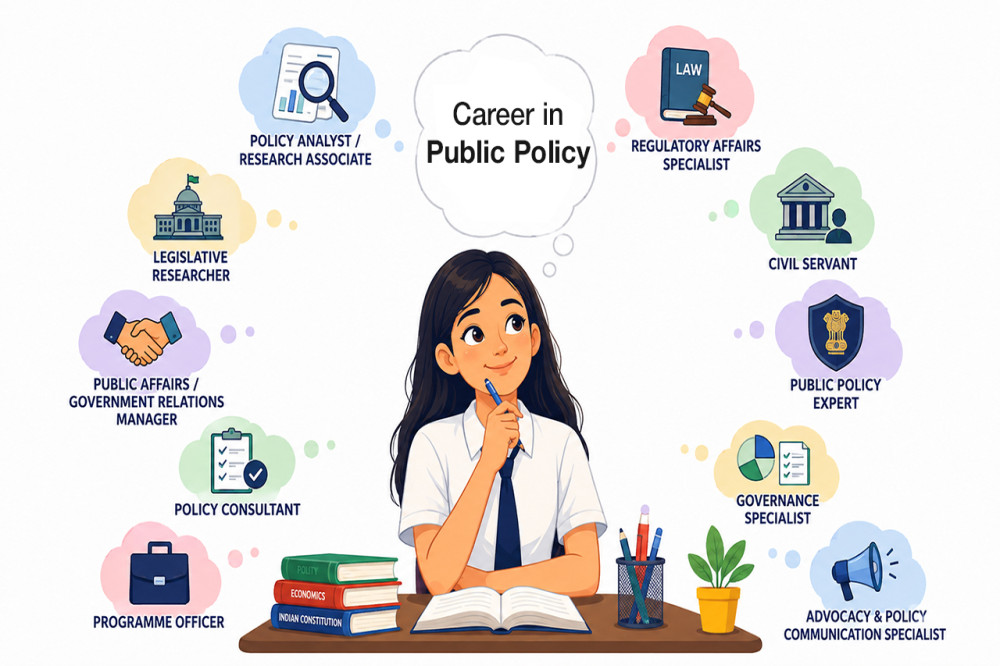
What You Can Become: Career Roles in Public Policy

  • Policy Analyst / Research Associate — at think tanks and research institutions
  • Legislative Researcher — supporting MPs, MLAs, and parliamentary committees
  • Public Affairs / Government Relations Manager — in corporates and industry bodies
  • Policy Consultant — at consulting firms advising governments and businesses
  • Programme Officer — at NGOs and development organisations implementing policy on the ground
  • Regulatory Affairs Specialist — in sectors like fintech, healthcare, and technology
  • Civil Servant — through UPSC or state PSC examinations

Who Hires Public Policy Professionals in India

  • Government bodies: NITI Aayog, state planning departments, ministries
  • Think tanks: Centre for Policy Research (CPR), Observer Research Foundation (ORF), IDFC Institute, Brookings India
  • Multilateral and development organisations: World Bank, UNDP, UNICEF
  • Corporates: Public policy and government-affairs teams at major technology, fintech, and manufacturing companies
  • Consulting firms: Policy and regulatory advisory practices at large consulting houses
  • NGOs: Organisations working across education, health, and livelihoods policy

What This Pays in India

Public policy salaries in India vary significantly by sector and experience level:

  • Entry-level (0–2 years): ₹4–8 LPA, typically at think tanks, NGOs, or as junior research associates
  • Mid-level (5–10 years): ₹12–25 LPA, in consulting firms, corporate public-affairs teams, or senior think-tank roles
  • Senior-level (10+ years): ₹30 LPA and above, at director or partner level in consulting, or leadership roles in corporate government-relations teams

Graduates from top MPP programmes (IIM Bangalore, Jindal School of Government, TISS, Ashoka) tend to command salaries at the higher end of these bands right from their first job, especially when moving into corporate public-affairs roles.


Is a Career in Public Policy Right for You?

This field suits students who enjoy reading, research, and structured argument, and who want their work to have a visible impact on society without necessarily entering electoral politics. It particularly fits students strong in economics, political science, or law, and those comfortable working with both data and written analysis. It is less suited to students looking for a fixed, highly structured career path — public policy careers often require navigating ambiguity, building networks, and being proactive about opportunities, especially in the early years.


Public policy offers students a way to work on issues that shape millions of lives — education access, healthcare delivery, climate resilience, urban infrastructure — through research and analysis rather than electoral politics. For students in Odisha weighing this path, the key decisions are which undergraduate stream to choose, which postgraduate programme to target, and how early to start building relevant research and writing skills.


Talk to Career Map

Confused about which career path is right for you? Let <u>Career Map</u> guide the way.

From research-driven careers like Public Policy to emerging and traditional career paths, our expert counsellors help students and parents in Odisha make informed, future-ready decisions — backed by assessments, one-on-one counselling, and real industry insight.


Visit us at www.thecareermap.in

Career Map Guiding Careers, Shaping Futures.


BIBLIOGRAPHY

https://www.ispp.org.in/public-policy-careers-that-put-you-at-the-heart-of-indias-development/

https://www.ispp.org.in/careers-in-public-policy-in-india/

https://onlinecourses.bsg.ox.ac.uk/blog/public-policy-skills-you-need-to-grow-your-career

https://theindiahouse.org/careers-in-public-policy-where-to-start/

https://www.impriindia.com/insights/pathway-publicpolicy-carer-pol-science/

https://rebouncecareers.com/how-to-start-a-career-in-public-policy-courses-skills-opportunities/

FAQs

No — public policy is research and analysis-driven work; politics involves elections and party affiliation, and most policy professionals never contest elections.

Undergraduate options in Odisha are limited, so most students move to cities like Delhi, Bengaluru, or Sonipat for specialised public policy degrees, especially at the postgraduate level.

No — students from economics, engineering, law, commerce, and other backgrounds are regularly admitted to MPP programmes.

No — think tanks, NGOs, consulting firms, and corporate public-affairs teams all hire policy professionals directly, without a civil services exam.

Humanities with Political Science, Economics, and Sociology is the strongest preparation, though Commerce and even Science students can transition into public policy later.

Most specialised roles are concentrated in Delhi and Bengaluru, though state government projects, NGOs, and CSR-linked policy work do offer some opportunities within Odisha, including Bhubaneswar.

Hello !!
I'm a Career Bee

  • Hi! 🖐. I’m Career Bee. How can I assist you today?

  • Choose your Gender