
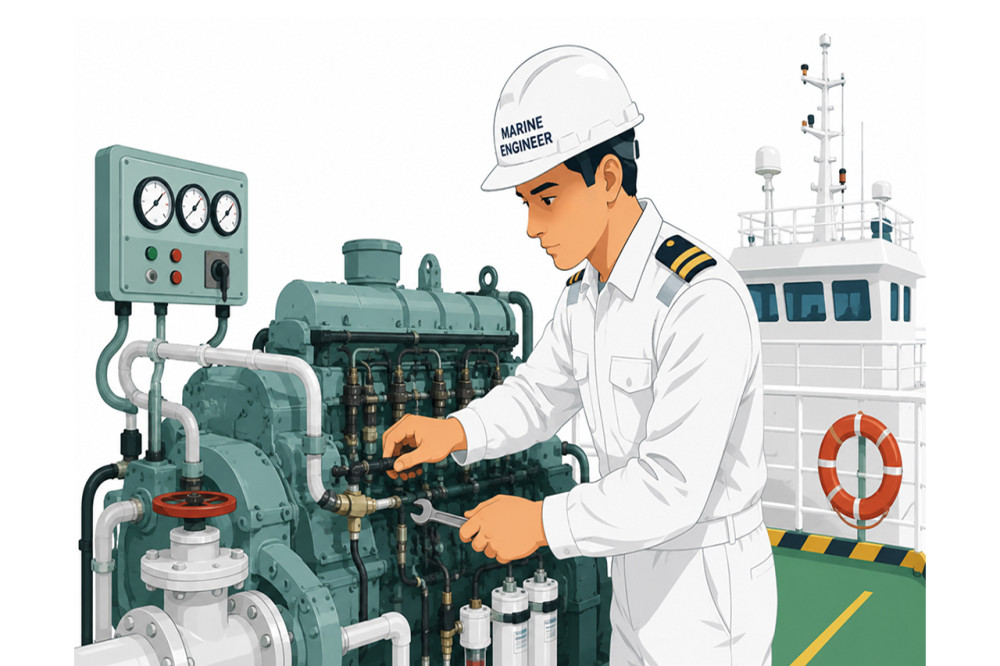
Every ship that crosses an ocean depends on a machine room most passengers never see — engines, generators, pumps, and cooling systems that must run flawlessly for weeks at sea, with no possibility of calling a mechanic. Marine Engineering is the career built to keep that machine room running, and it remains one of India's most rewarding, if under-discussed, four-year engineering degrees — combining strong pay, a genuinely rare skill set, and, for Odisha students, a direct local connection through Paradip Port.
A Marine Engineer designs, operates, and maintains the mechanical and electrical systems that keep a ship functioning — engines, propulsion systems, generators, pumps, refrigeration, and other onboard machinery. The job combines fluid mechanics, materials science, power generation, and increasingly, computer-based systems, into one highly practical, hands-on engineering discipline. Core responsibilities include:
Because marine engineering remains a relatively rare specialisation compared to mainstream engineering branches, the demand-to-workforce ratio favours graduates — industry sources consistently note that this scarcity works in students' favour when it comes to placements and pay.
Salary benchmarks are strong across the board — recent industry data puts the average marine engineer salary in India at roughly ₹10.17 LPA across all sectors, one of the strongest benchmarks among all four-year engineering degrees in the country.
The career offers a clear, structured path both at sea and on shore — meaning a marine engineer isn't locked into sailing for their entire career if their priorities change over time.
Tax efficiency is a genuine, built-in advantage — qualifying seafarers who meet NRI tax status conditions can receive a significant portion of their sea-time income largely tax-free, a benefit almost no shore-based engineering career offers.
B.Tech in Marine Engineering (4 years): The primary and most direct route, requiring Class 12 with at least 60% in Physics, Chemistry, and Mathematics (PCM), followed by qualifying the IMU CET (Indian Maritime University Common Entrance Test) — some institutes also accept JEE Main scores.
Graduate Marine Engineering (GME): A lateral-entry route specifically for students who already hold a B.Tech/B.E. in Mechanical Engineering (or a closely related discipline) and want to become marine engineering officers without repeating a full four-year marine degree — widely considered one of the cleanest entry routes into this career for mechanical graduates.
Top institutes in India include government colleges like MERI Mumbai and MERI Kolkata, alongside private institutes offering company-sponsored seats — for example, tie-ups with shipping majors like Maersk and MSC, which can significantly improve placement certainty.
Course fees vary considerably — government colleges typically range from ₹1–11 lakh for the full course, while private institutes can range from ₹2.5–24 lakh, depending on sponsorship and facilities.
The selection process typically runs through four stages: the IMU CET exam, spot counselling, a medical examination, and document submission — with medical eligibility (including specific eyesight standards and no colour blindness) being non-negotiable given the safety-critical nature of the work.
Marine engineers who choose to sail typically progress through a structured, experience-based rank ladder:
Engine Cadet → 4th Engineer → 3rd Engineer → 2nd Engineer → Chief Engineer
Each promotion is tied to sea time, departmental exams, and experience, similar in structure to the Deck Officer career ladder. Marine engineers who eventually move ashore have a genuinely wide range of onshore options too, including roles as a Port Engineer, Maritime Maintenance Engineer, Naval Architect, Ship Engineer, or Marine Equipment Specialist — meaning the career doesn't require a lifetime at sea to remain financially rewarding.
For Odisha students, this career has a genuinely local anchor point: Paradip Port Authority, located in Jagatsinghpur district, is one of India's major ports and actively recruits for Marine Engineer (Class-I) positions responsible for the maintenance and operation of the port's dredgers and marine equipment — meaning qualified marine engineers can find real, salaried opportunities without needing to join a sailing contract abroad. As one of India's leading ports on the East Coast, Paradip's continued expansion (including its growing role in green hydrogen and ammonia exports, covered in our earlier Green Hydrogen blog) means demand for both sailing and shore-based marine engineering talent in the state is only expected to grow.
Entry-level marine engineers in India: roughly ₹4–7 LPA as a starting range, with some sources citing fresh graduate packages up to ₹6–12 LPA depending on the sponsoring company and institute.
Average marine engineer salary in India across all sectors: approximately ₹10.17 LPA, according to recent industry salary data — a strong benchmark among four-year engineering degrees.
Chief Marine Engineers in India: average around ₹10.54 LPA, with senior Chief Engineers on international LNG and chemical tankers earning ₹15–20 lakh per month — largely tax-free for those meeting NRI-qualifying seafarer status.
Onshore marine engineering roles — including port-based positions like those at Paradip Port — offer stable, structured government-linked pay scales as an alternative to sea-going contracts.
The investment in a marine engineering degree — from roughly ₹4 lakh at a government college to ₹20+ lakh at a sponsored private institute — is often described by industry sources as paying back within just 2–3 ship contracts, given the strength of early-career sea-time pay.
This path tends to suit students who:
Marine Engineering offers Odisha students a rare combination: one of India's strongest engineering salary benchmarks, a genuinely scarce skill set, and — thanks to Paradip Port's direct recruitment — a real local pathway into the field. For PCM students weighing this against mainstream engineering branches, this is a career worth serious research before finalising a stream after Class 12.
Confused about which career path is right for you? Let <u>Career Map</u> guide the way.
From technical maritime careers like Marine Engineering to emerging and traditional career paths, our expert counsellors help students and parents in Odisha make informed, future-ready decisions — backed by assessments, one-on-one counselling, and real industry insight.
📍 Visit us at www.thecareermap.in
Career Map — Guiding Careers, Shaping Futures.





Hello !!
I'm a Career Bee