
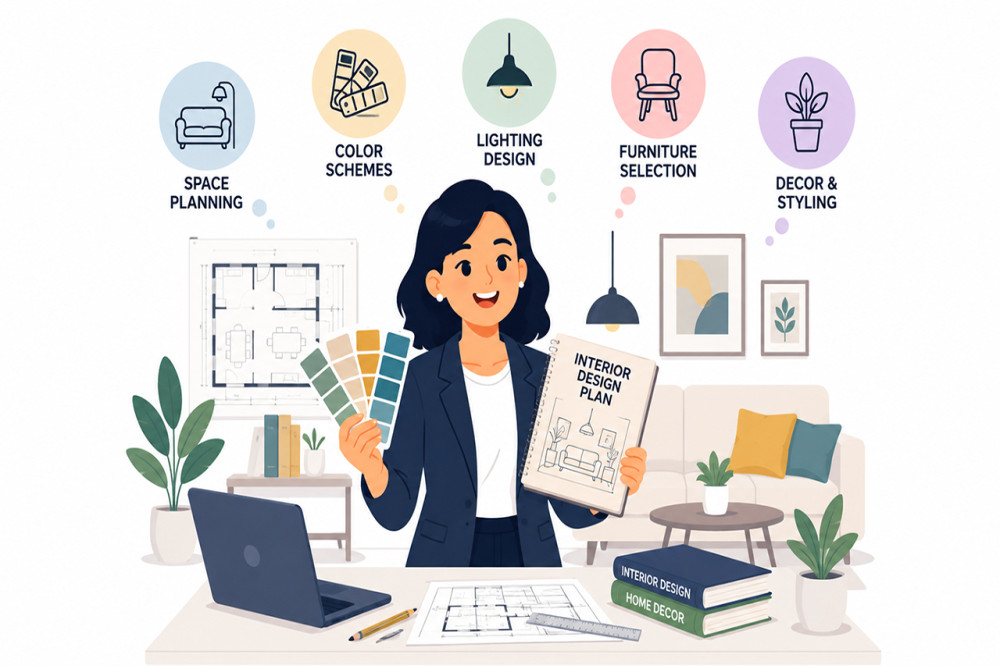
Interior Design is the professional discipline of planning, shaping, and detailing indoor spaces — homes, offices, hotels, restaurants, retail stores, hospitals, and institutional buildings — so that they are functional, safe, and visually coherent, not just decorated. It sits at the intersection of aesthetics and technical execution: an interior designer works with space planning, materials, lighting, furniture, colour, and building codes, while also coordinating with architects, contractors, and vendors to actually get a project built.
In simple terms: decorating a room and designing it are two different things. Design starts with how a space will actually be used — the flow of movement, the lighting for a task, the acoustics of a restaurant, the storage a family really needs — and only then moves to how it should look. That combination of planning and problem-solving is what separates a trained interior designer from someone with a good eye for furniture.
India's interior design market generated USD 36.89 billion in revenue in 2025 and is projected to reach USD 74.73 billion by 2034, so this is a sector expanding fast enough to absorb a steady stream of new professionals for years to come.
Rising urbanisation, growing real estate investment, and increasing consumer spending on home improvement are the core drivers of this growth, alongside government housing and urban infrastructure programmes generating demand for organised interior design services.
Residential interiors are actually the fastest-growing segment, forecast to expand at roughly 16.5% CAGR through 2031, as rising incomes and finished-housing mandates convert more households into paying clients for design work.
Despite this scale, the sector is still strikingly under-professionalised — only around 10-23% of practising interior designers in India have any formal design qualification, according to FICCI and the Council of Architecture, and the NSDC projects a shortage of roughly 1.2 million skilled design professionals. That gap is precisely what makes a formal design education a real differentiator rather than a nice-to-have.
Organised, tech-enabled design platforms are also professionalising the industry from the top down — Livspace alone reported 23% year-on-year revenue growth in FY25 and is expanding from 150+ stores in 90 cities toward over 200 stores in 100+ cities, which means structured, salaried design roles are growing alongside the traditional freelance and studio route.
NID (National Institute of Design), Ahmedabad is widely regarded as India's most prestigious design institute, with strong programmes in furniture and interior environments.
CEPT University, Ahmedabad is consistently ranked among the top choices specifically for interior architecture.
Pearl Academy (Delhi, Mumbai, Jaipur, Noida) is known for global exposure, strong portfolio-based training, and international university tie-ups.
NIFT campuses offer interior-adjacent design specialisations, though NIFT itself is primarily a fashion-focused institute.
MIT Institute of Design, Pune and Symbiosis Institute of Design, Pune are well-regarded options beyond the NID/NIFT circuit.
JJ School of Art, Mumbai and the School of Planning and Architecture network are established government options.
Entrance exams accepted across these institutes include NID DAT, CEED, UCEED, NATA, CUET, and individual institute-level exams like the Pearl Academy Entrance Exam and MITID DAT, depending on the specific programme.
For Odisha students, this career no longer means relocating on day one — Bhubaneswar now has a genuine, if still developing, cluster of design institutes offering interior design training right in the city:
Bhubaneswar is home to institutes such as the International School of Design (INSD), which positions itself as an internationally accredited design school in Eastern India, and JD Institute of Fashion Technology, Bhubaneswar, established in 2013, offering interior design alongside fashion and visual merchandising.
Trytoon Academy, affiliated with Utkal University of Culture and recognised by the Government of Odisha, runs interior design programmes across certificate, diploma, and degree levels, and is one of the more established local names in the city's design education space.
At the state level, Sri Sri University and Utkal University of Culture are counted among Odisha's known names for interior design education, typically admitting students through university-level entrance tests, a portfolio review, and a personal interview.
For Odisha students who do want to target India's top-tier national institutes, the same national entrance exams — NID DAT, CEED, UCEED, NATA, and CUET — apply regardless of home state, and a strong portfolio built locally in Bhubaneswar can travel with the student into these national admission processes.
A local institute is genuinely useful for building the foundational and portfolio skills, but students should weigh institute accreditation, faculty industry background, and placement track record carefully — Odisha's design education ecosystem is still growing, and choosing the right institute matters more here than in cities with a longer design-education history.
For a student in Odisha, this combination — a real local starting point plus full access to the same national entrance exams as everyone else — makes interior design a career that can genuinely begin at home, even if some students choose to move for a top-tier institute later.
Graduates move into roles across design studios, real estate developers, hospitality chains, and independent practice, including:
Residential Interior Designer — planning and detailing homes and apartments, from space layout to material and furniture selection.
Commercial / Workplace Designer — designing offices, retail stores, and co-working spaces, balancing brand identity with functional layout.
Hospitality Designer — working on hotels, restaurants, and resorts, a fast-growing niche as India's hospitality sector expands.
Set / Exhibition / Event Designer — designing temporary interiors for films, television, exhibitions, and events.
3D Visualiser / CAD Designer — producing the technical drawings and renders that turn a design concept into a buildable plan, often an entry point role for freshers.
Design Consultant / Freelancer — taking on independent client projects once a strong portfolio and reputation are built, with earning potential that scales well beyond salaried roles.
Recruiters span organised design platforms, real estate developers, hospitality groups, and manufacturing-linked design firms, reflecting how broad this field has become: Livspace, HomeLane, Godrej Interio, Asian Paints (through its design verticals), DLF, well-known architecture and interior design studios, hotel chains, and independent boutique design practices — giving graduates a choice between structured corporate roles and independent, portfolio-driven practice.
Interior design salaries vary widely depending on source, city, qualification, and whether a designer is salaried or independent, but a consistent range emerges across multiple industry sources:
Entry-level / fresher roles: most sources place this between ₹2–4.5 LPA (roughly ₹20,000–30,000 a month), typically as a junior designer, design assistant, or 3D visualiser; graduates placed at organised platforms like Livspace or HomeLane often start toward the higher end of this range with a structured growth path.
Diploma-holders specifically tend to start lower, generally in the ₹2.5–5 LPA range, reflecting the gap between diploma and full degree qualifications.
Mid-career professionals with a few years of experience handling independent projects and client relationships typically earn ₹5–8 LPA.
Senior designers and consultants, especially those with a strong portfolio and industry reputation, can earn ₹15 LPA or more in salaried roles, with senior roles at large firms occasionally crossing this comfortably.
Freelancers and independent practitioners have the widest range of all — well-established freelancers can earn ₹50,000 to ₹1 lakh a month or more, scaling with the size and prestige of the projects they take on, since freelance and consultancy work offers effectively unlimited upside compared to a fixed salary.
This path tends to suit students who:
Have a genuine eye for space, proportion, colour, and detail — and are willing to pair that instinct with technical training in materials, codes, and project execution.
Want a creative career with a tangible, physical output — a finished room, store, or hotel lobby that people actually use.
Are comfortable working across both creative design thinking and the more practical, deadline-driven world of vendors, budgets, and site visits.
Are prepared to build a strong portfolio early, since portfolio quality — more than the college name alone — is what most employers and clients actually evaluate.
Confused about which career path is right for you? Let <u>Career Map</u> guide the way.
From impactful careers like Interior Design to emerging and traditional career paths, our expert counsellors help students and parents in Odisha make informed, future-ready decisions — backed by assessments, one-on-one counselling, and real industry insight.
Visit us at www.thecareermap.in
Career Map — Guiding Careers, Shaping Futures.
https://www.iiad.edu.in/the-circle/is-an-interior-design-career-a-good-choice/
https://www.hamstech.com/hamstech-blog/transform-spaces-with-interior-designing
https://msdcskills.org/career-path-in-interior-design/
https://www.artemisiacollege.com/blog/scope-of-interior-designing/
https://www.lpu.in/blog/career-paths-after-b-design-interior-and-furniture/
https://www.pearlacademy.com/blog/interiors/interior-design-career-paths





Hello !!
I'm a Career Bee